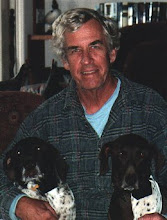

I mentioned coyotes, which also roam the vineyard at night, and they too, feed on gophers and ground squirrels(another pest that digs up the vineyard and eats grapevine roots). We have literally hundreds of coyotes that visit the vineyard on a daily/nightly basis, and keeping them out with deer fence just doesn't work. Normally I wouldn't mind the coyotes, but they also eat dogs...and Cazadora and Cartucho have no idea of how dangerous these coyotes are. More than anything our dogs are keenly interested in these animals that truly do look somewhat like dogs, and a careless dog who ventures too far away from his protector is very likely to become dinner for a pack of coyotes that stealthily lies in wait for our dogs to come too close to them.
As big as Cerro Prieto is( 73 acres with over 5000 oak trees) it makes ideal hunting ground for dogs by coyotes. Again this is part of the ecologic system of Cerro Prieto, and whereas it is nice to have the coyotes help to keep the gopher, ground squirrel and raccoon population under control, it is nicer yet to have our great dogs around us as constant companions. Given a chance I will shoot any coyote I see, but the vineyard is surrounded by trees, trees, and more trees, which makes a shot at a coyote almost impossible. Occasionally, however, a deer gets under our deer fence (their front shoulders dislocate and they come thru coyote holes dug under the deer fence). It is then that we get visited by a pair of mountain lions, hell bent on catching a fenced in deer. Yes, this is survival of the fittest, but it is also part and parcel of our ecology.
Should a raccoon, a ground squirrel, a skunk or whatever else die, we have an airborne armada of turkey vultures to clean up the mess. Usually they ride the air currents that flow thru our valleys and mountains, but often they can also be seen circling, sometimes as high as a mile or more, where they can smell the putrid remains of a dead animal. Their olfactory system can sense a rotting animal from heights as great as 5000 to 10,000 feet. It is an adaptive change, a special sense they have developed over thousands of years, that allows them to find carrion by smell. They literally are the garbage collectors of nature, cleaning up whatever is left rotting in the sun, whether hit by a cement truck, or killed by another predator. It is fascinating to watch the vultures, coyotes, and yellow jackets all jockey for a position at the table of a dead animal. There is some hierarchy as to who eats what, where, and when, but amazingly, all three carnivores seem to take turns, fill their stomachs, and somehow still manage to coexist. Wasps don't bother the coyotes, the coyotes don't bother the vultures, and the vultures are smart enough to give both a wide berth.
Wild turkeys can frequently be seen in our vineyard, occasionally a flock of 20 or more, and they always visit when there are grapes on the vines. Again these are virtually impossible to scare away, or shoot (because they are in and around the vines), but a pack of coyotes can put them to flight in the blink of an eye. It is rare for a coyote to catch a mature turkey, but they have a field day once the turkey eggs hatch.
With the incredibly wet winter and somewhat warmer days, mushrooms have sprouted and I have been eagerly hunting them. The north facing slopes of all mountains, complete with plenty of shade, have become ideal sites for the mushrooms to spring up. Deadfall---twigs and branches---and especially mounds of leaves that have been accumulating since eons ago, have made a mulch that in many places is 2-3 feet thick, and has become primo mushroom hunting territory. Yesterday morning in between rains, I picked 37 different varieties of mushrooms in less than 3 hours. No, I did not eat them, but yes, I have spent the last day trying to identify all of them. This is not in the vineyard proper, but is definitely part of the vineyard ecologic system, as all mushroom areas are on the border of Cerro Prieto.
Some years back we seeded, reseeded, and then reseeded again, throughout all of our vineyard rows. In addition to wildflowers we established bromes, vetch, ryes, clovers, and filaree, all of which help keep the topsoil in our steeply sloped mountain vineyard. In big rain years such as el nino of 2010, without our ground cover, we would have had terrible erosion and actual loss of entire rows. Even with ground cover the last el nino wiped out over
5 partial rows, costing $1000 per 50 feet of lost row to rebuild. We lost over 500 feet of vineyard rows at a price tag of some $5000. At that stage we had just established our ground cover, but hadn't yet learned that degrees of inclination exceeding 45 degrees or more require that hay or straw be put out by hand immediately after seeding, to insure that planted seeds are not carried away by torrential rains. Now, with ground cover established, we still need to put out hay in death defyingly steep slopes. Altho we know the potential areas of erosion, we still have to put out 90 bales of hay or straw each season. To not do so just invites severe erosion and a mass disturbance in the ecology of Cerro Prieto vineyard. Continued in Part 3.
As big as Cerro Prieto is( 73 acres with over 5000 oak trees) it makes ideal hunting ground for dogs by coyotes. Again this is part of the ecologic system of Cerro Prieto, and whereas it is nice to have the coyotes help to keep the gopher, ground squirrel and raccoon population under control, it is nicer yet to have our great dogs around us as constant companions. Given a chance I will shoot any coyote I see, but the vineyard is surrounded by trees, trees, and more trees, which makes a shot at a coyote almost impossible. Occasionally, however, a deer gets under our deer fence (their front shoulders dislocate and they come thru coyote holes dug under the deer fence). It is then that we get visited by a pair of mountain lions, hell bent on catching a fenced in deer. Yes, this is survival of the fittest, but it is also part and parcel of our ecology.
Should a raccoon, a ground squirrel, a skunk or whatever else die, we have an airborne armada of turkey vultures to clean up the mess. Usually they ride the air currents that flow thru our valleys and mountains, but often they can also be seen circling, sometimes as high as a mile or more, where they can smell the putrid remains of a dead animal. Their olfactory system can sense a rotting animal from heights as great as 5000 to 10,000 feet. It is an adaptive change, a special sense they have developed over thousands of years, that allows them to find carrion by smell. They literally are the garbage collectors of nature, cleaning up whatever is left rotting in the sun, whether hit by a cement truck, or killed by another predator. It is fascinating to watch the vultures, coyotes, and yellow jackets all jockey for a position at the table of a dead animal. There is some hierarchy as to who eats what, where, and when, but amazingly, all three carnivores seem to take turns, fill their stomachs, and somehow still manage to coexist. Wasps don't bother the coyotes, the coyotes don't bother the vultures, and the vultures are smart enough to give both a wide berth.
Wild turkeys can frequently be seen in our vineyard, occasionally a flock of 20 or more, and they always visit when there are grapes on the vines. Again these are virtually impossible to scare away, or shoot (because they are in and around the vines), but a pack of coyotes can put them to flight in the blink of an eye. It is rare for a coyote to catch a mature turkey, but they have a field day once the turkey eggs hatch.
With the incredibly wet winter and somewhat warmer days, mushrooms have sprouted and I have been eagerly hunting them. The north facing slopes of all mountains, complete with plenty of shade, have become ideal sites for the mushrooms to spring up. Deadfall---twigs and branches---and especially mounds of leaves that have been accumulating since eons ago, have made a mulch that in many places is 2-3 feet thick, and has become primo mushroom hunting territory. Yesterday morning in between rains, I picked 37 different varieties of mushrooms in less than 3 hours. No, I did not eat them, but yes, I have spent the last day trying to identify all of them. This is not in the vineyard proper, but is definitely part of the vineyard ecologic system, as all mushroom areas are on the border of Cerro Prieto.
Some years back we seeded, reseeded, and then reseeded again, throughout all of our vineyard rows. In addition to wildflowers we established bromes, vetch, ryes, clovers, and filaree, all of which help keep the topsoil in our steeply sloped mountain vineyard. In big rain years such as el nino of 2010, without our ground cover, we would have had terrible erosion and actual loss of entire rows. Even with ground cover the last el nino wiped out over
5 partial rows, costing $1000 per 50 feet of lost row to rebuild. We lost over 500 feet of vineyard rows at a price tag of some $5000. At that stage we had just established our ground cover, but hadn't yet learned that degrees of inclination exceeding 45 degrees or more require that hay or straw be put out by hand immediately after seeding, to insure that planted seeds are not carried away by torrential rains. Now, with ground cover established, we still need to put out hay in death defyingly steep slopes. Altho we know the potential areas of erosion, we still have to put out 90 bales of hay or straw each season. To not do so just invites severe erosion and a mass disturbance in the ecology of Cerro Prieto vineyard. Continued in Part 3.

